Technical Report
“Electroless Plating”
Development of PFAS-Free Electroless
Composite Plating Technologies
-Use for sliding parts contributes to solving a societal issue-
Nihon Kagaku Sangyo Co., Ltd. (President: KADOYA Hiroki) has been working on the technical development of electroless composite plating that does not contain per- and polyfluoroalkyl substances (PFAS), which are seen as a concern worldwide, especially in the EU, due to their impact on human health and the natural environment. Our efforts in this regard draw on our many years spent developing surface treatment agents and our know-how regarding associated manufacturing technologies. As a result, we succeeded in developing two proprietary electroless composite plating technologies that combine improved performance with being PFAS-free, and filed patent applications for these technologies in 2022 and 2024.
【Background to the development】
Composite plating using polytetrafluoroethylene (PTFE), which is a form of PFAS, generally has a low friction coefficient and superb durability, and it is therefore widely used for sliding parts and similar applications. On the other hand, PFAS have high chemical stability and thus remain and accumulate in the environment for prolonged periods without being decomposed. Consequently, their impact on human health and the natural environment is regarded as a cause for concern and regulation of PFAS is under way around the world. At Nihon Kagaku Sangyo, we had anticipated that PFAS regulation would gain momentum in the near future and have therefore been developing PFAS-free composite plating technologies for some time already, aiming to take the lead in helping to solve the societal issue posed by these substances.
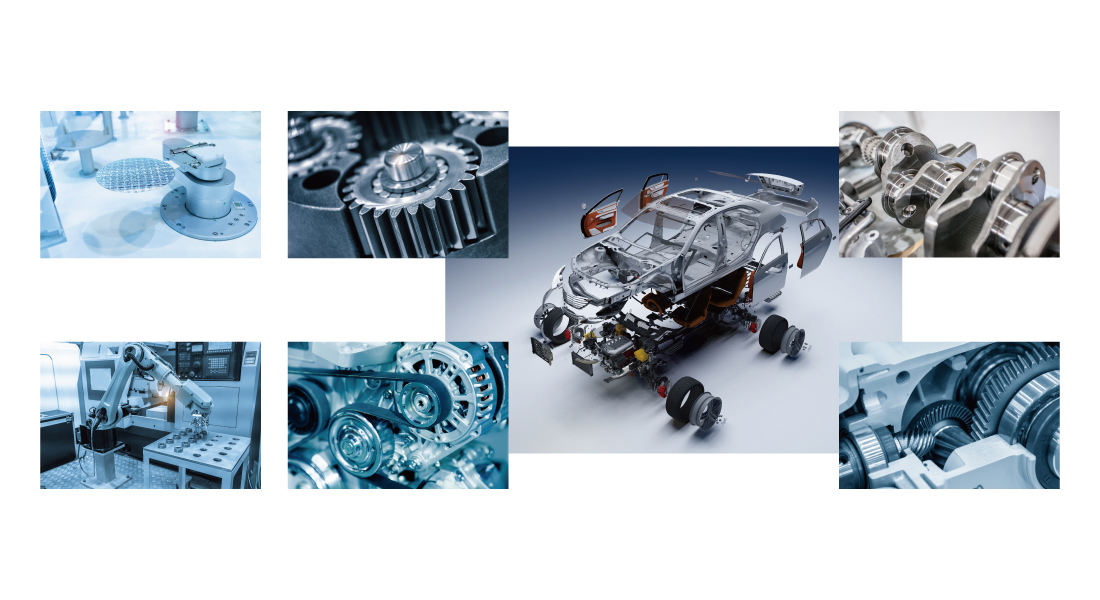
Furthermore, the advancement of technologies in sectors such as automobiles, aerospace, heavy industry, semiconductor, and electronic components, means that the level of performance required from surface treatment agents is increasing. Even in the auto industry, for example, the rapid transition to electric vehicles means such agents are now expected to deliver features such as minimal environmental impact as well as the functionality required for these vehicles’ sliding parts.
We therefore decided to take our proprietary surface treatment technologies further to respond to these needs by developing electroless composite plating technologies combining improved performance and PFAS-free.
【What is the core technology underlying PFAS-free composite plating?】
For many years, we have been meeting needs for surface treatment in diverse applications such as electronic components, plastic molding, and electroforming by supplying various raw materials for plating solutions and chemicals for electroless plating, alongside developing plating processes. The resulting know-how relating to metal salts (primarily nonferrous) provided the basis for us to take on the development of technologies that would address both the societal issue of eliminating PFAS and the manufacturing community’s demands for improved performance.
As a result of exploring the options, we succeeded in selecting composite materials to replace PTFE and developing a core technology to disperse and stabilize those materials. This technology can be used without any new capital investment by customers currently engaged in PTFE composite plating.
The new core technology means that PFAS-free composite plating can not only be used as a substitute for PTFE composite plating, but also offers wide-ranging potential in applications where use of PTFE composite plating has proved difficult in the past.
<Core techology>Minute particle distribution technology
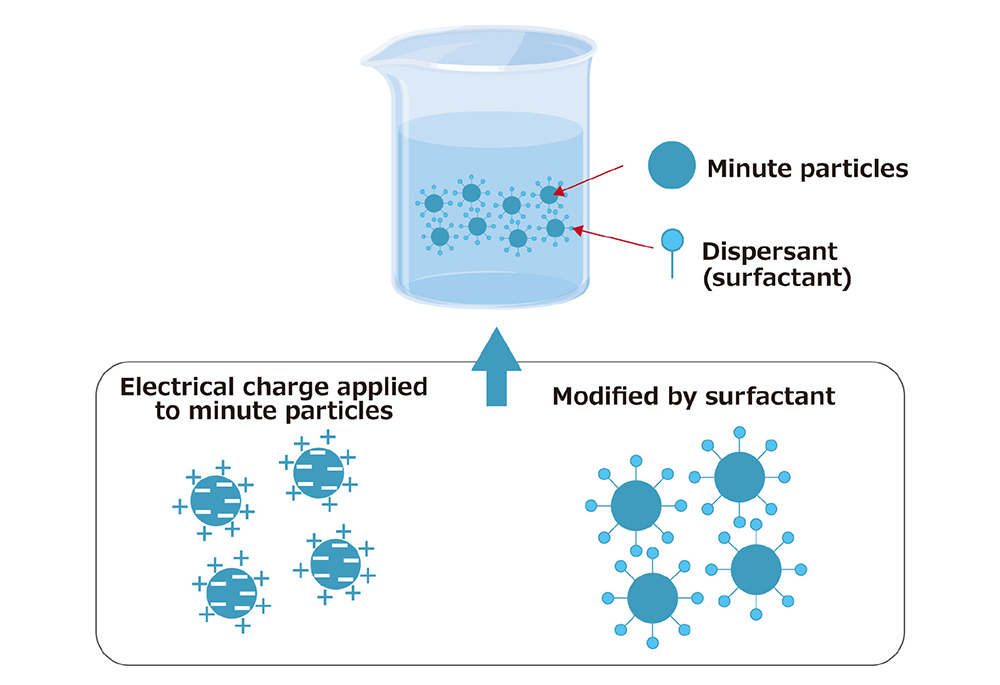
The co-deposition of minute particles of substances such as the new resin powder and mica in the plating coat make it possible to impart characteristics such as sliding performance, hardness, and abrasion resistance that cannot be obtained by metal coating alone.
This is where our proprietary minute particle distribution technology—which controls the surface condition of the minute particles—comes into play.
・
Technology that optimizes condition of minute particles via co-deposition
・
Technology that produces optimal surface charge and particle size distribution
<Key features of new plating technologies>
Technology using resin powder
as the composite material
- Composite plating that offers hydrophobicity and low friction, as well as being oleophilic -
・
We drew on our proprietary know-how regarding particle distribution and use of co-deposition in plating to add a resin powder that easily forms a composite with the plating solution and performs well. This enabled us to achieve uniform particle co-deposition irrespective of the plated surface’s orientation, which is typically difficult to achieve during composite plating.
・
While aiming for the same level of hydrophobicity and low friction as PTFE composite plating, the new plating is oleophilic, which allows it to work well with lubricant oil. This offers greater design flexibility with regard to sliding parts, for which use in conjunction with lubricant oil is a given.
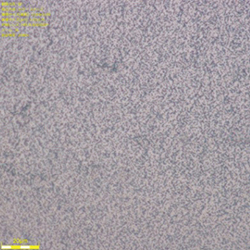
Plating surface
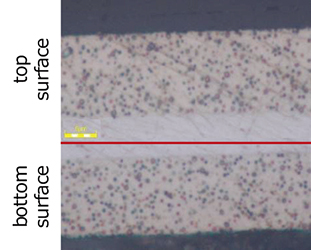
Cross section
- 【Anticipated needs】
・
Semiconductor manufacturing equipment: Conveying, lifting, and positioning mechanisms; sliding parts for valves and cylinders
・
Electronic components and precision instruments: Actuator components and assembly jigs
・
Automobiles and EVs: Sliding and moving parts, mechanical assemblies requiring durable sliding
Technology using mica
as the composite material
- Low-friction plating resistant to seizure -
・
Use of mica has enabled PFAS-free composite plating that leverages mica’s characteristics as solid lubricant to aim for seizure resistance and sliding stability.
・
We succeeded in simultaneously solving several problems with regard to PTFE composite plating, such as the difficulty associated with chemical liquid control during the manufacturing and handling of plating solutions, and the use of large volumes of surfactant.
・
Unlike with PTFE composite plating, there is no reduction in the hardness of the plating coat, making it possible to maintain high abrasion resistance in the electroless nickel-phosphorus coating while reducing the friction coefficient.
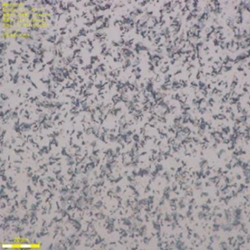
Plating surface
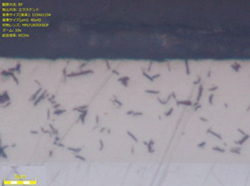
Cross section
- 【Anticipated needs】
・
Automobiles, aerospace, and heavy industry: High-load and high-surface-pressure sliding, and locations where seizure resistance is important
・
Molds and plastic-molding components: Locations involving sliding and durability
・
Industrial machinery and heavy industry: Sliding shafts, guides, prevention of seizure and improvement of durability in sliding parts
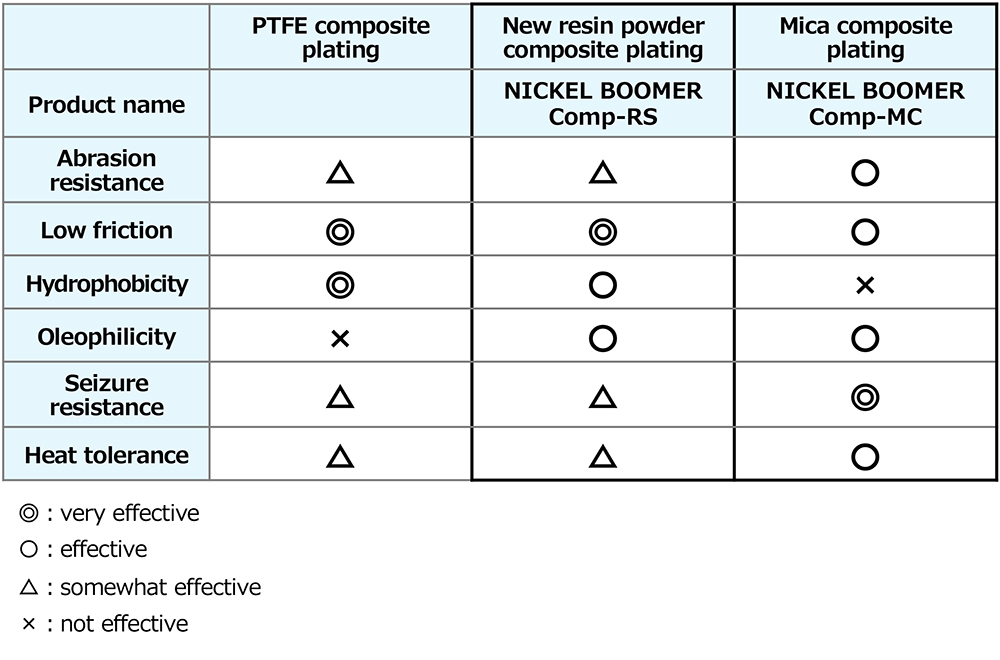
<Summary of technical features>
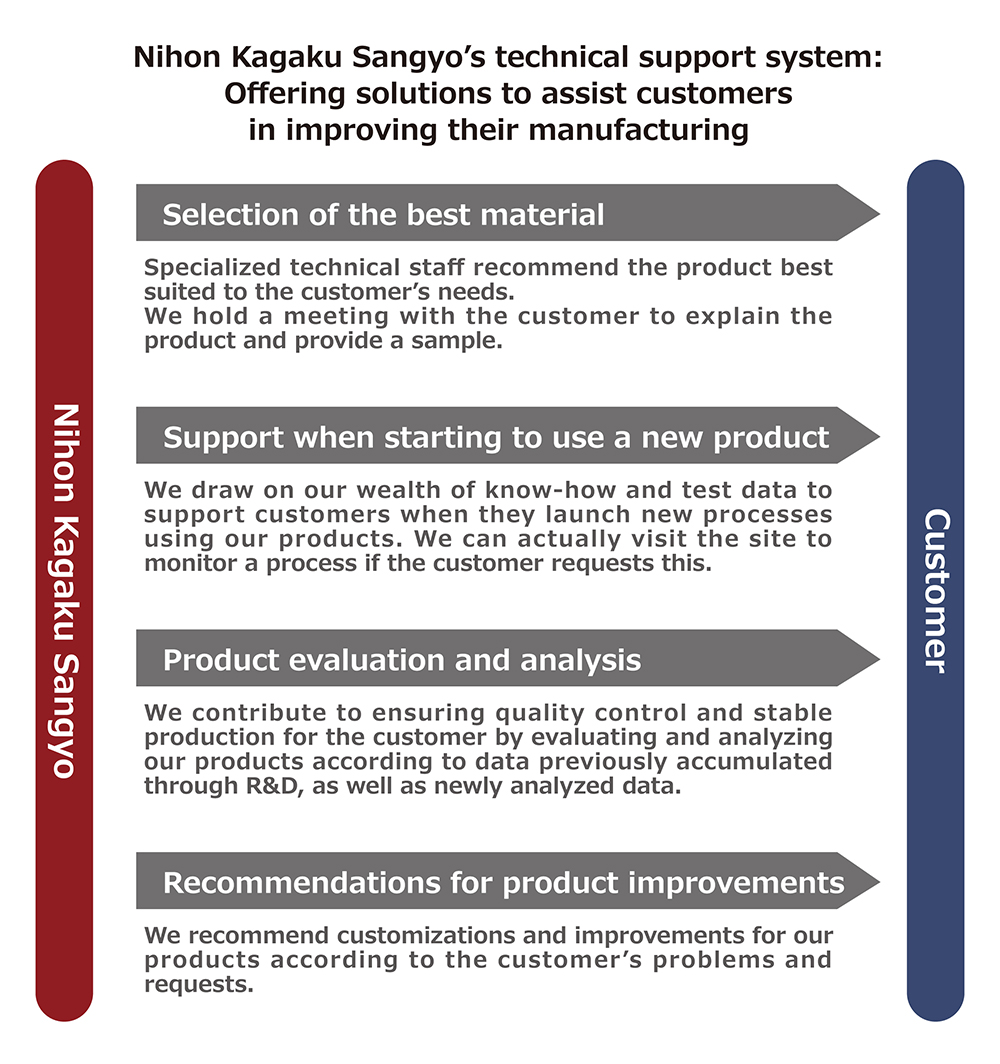
【Attentive technical support system】
We develop characteristic surface treatment agents at our R&D Center and operate an attentive technical support system. This system allows us to offer solutions that meet a diverse range of surface treatment needs, including PFAS-free composite plating, and are suitable for a broad range of substrate materials and shapes. Please do not hesitate to contact us with your inquiries.
Detailed product information and technical information on Electroless Plating,
can be downloaded fromhere.