Technical Report
“non-magnetic-nickel-sulfamate”
Non-magnetic Nickel-Phosphorus Alloy Plating
—Development using a nickel sulfamate bath—
For many years, Nihon Kagaku Sangyo Co., Ltd. (President: KADOYA Hiroki) has been meeting the needs for surface treatment in diverse applications such as electronic components, plastic molding, and electroforming . By leveraging our know-how in surface treatment, we supply nickel sulfamate products, as well as various sulfamate salts and additives, that meet a diverse range of needs.
As information technology (IT) has proliferated in recent years, electronic components in most IT devices have become even more sophisticated and highly integrated. This in turn has led to increasing demands being placed on the performance of surface treatment agents used for such IT devices.
At Nihon Kagaku Sangyo, we supply nickel sulfamate products, as well as various sulfamate salts and additives based on our proprietary core technology for surface treatment. These products, which allow a high degree of control over the plating layer in terms of precision, hardness, and internal stress, are trusted by many of our customers, both domestic and overseas.

【Why is “non-magnetic” technology required now?】
Our life evolves to be faster, smarter, and safer every day. However, behind this evolution, magnetism has emerged as an invisible challenge, as electronic components become even more densely packed and highly integrated. The influence of invisible magnetism can sometimes interfere with communication, undermine the quality of medical care, and cause malfunctions of precision instruments. To support future social infrastructure, technology to control this magnetism is essential.
What is required for the evolution of society: Technology to protect ordinary things in the future
Our society evolves into a future where the following things will become reality. Non-magnetic technology is required to realize this evolution.
・
Society where everything connects instantly
-
・
Ultra-high-speed and large-capacity communications (5G/6G) will become the norm, realizing remote operation without time lag and automatic operation.
・
Even more precise and safer medical care
-
・
Advanced medical devices, including a magnetic resonance imager (MRI), will be able to provide clearer images in a safer manner.
・
Wider use of smart devices that accurately detect information and respond
-
・
Sensors in smartphones and wearable devices will always detect accurate information without being affected by the surrounding magnetism.
・
Stronger platform that supports big data and AI
-
・
Semiconductors and servers that process massive amounts of data will continue to operate stably without causing errors resulting from the influence of magnetism.
Industry challenges: Fight against invisible magnetism
Various industries supporting the evolution of society have already faced specific challenges caused by magnetism.
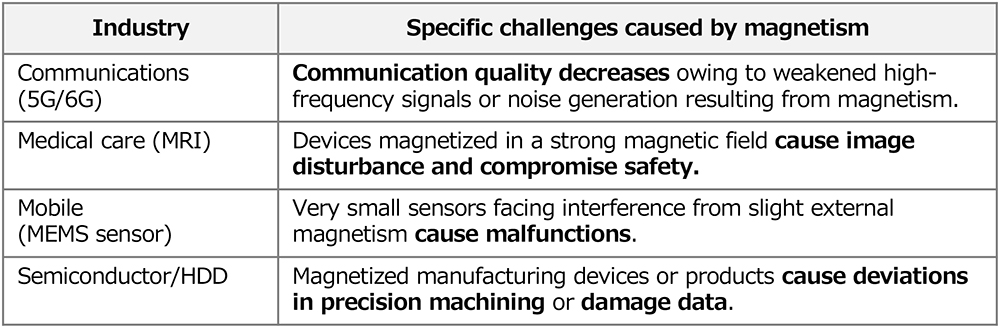
As described above, non-magnetic plating layer is an essential technology not only for particular industries but also for supporting our future life fundamentally. This Technical Report introduces “non-magnetic nickel-phosphorus alloy plating using a nickel sulfamate bath,” which we are developing to solve these challenges.
【Mechanism of non-magnetic nickel-phosphorus alloy plating】
<Mechanism of magnetism>
Substances have magnetic moments at the atomic level. Applying a magnetic field will align these moments in the direction of the magnetic field, causing magnetization.
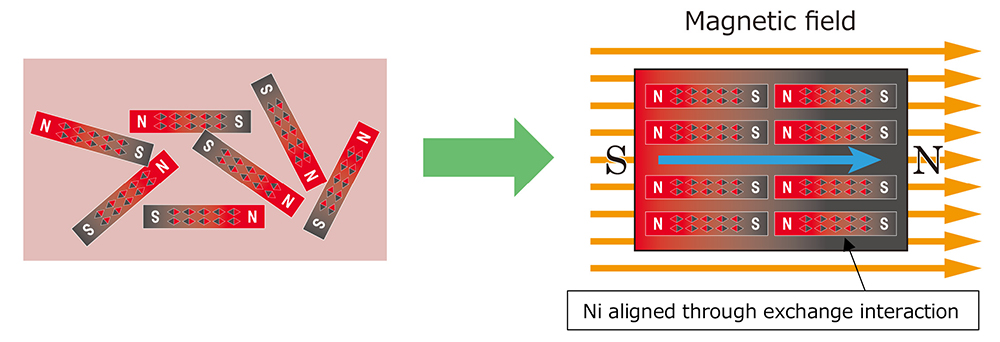
Ferromagnetics (e.g., nickel) have spontaneous magnetization, and the directions of magnetic moments in the magnetic domain are random within the substance; they are in the state of zero magnetization in totality.
Applying a magnetic field will expand the magnetic domain along the magnetic field, causing the magnetization of the entire substance. The alignment of magnetic moments through exchange interaction enhances magnetism.
<Mechanism of non-magnetism>
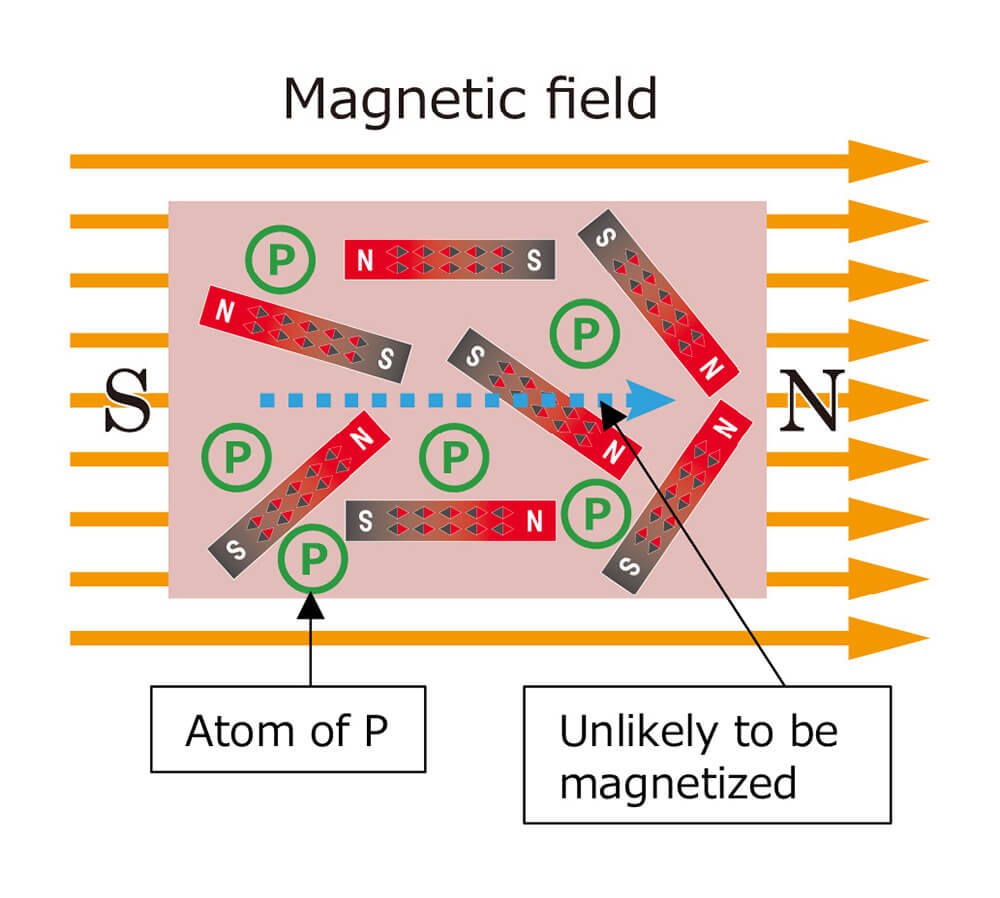
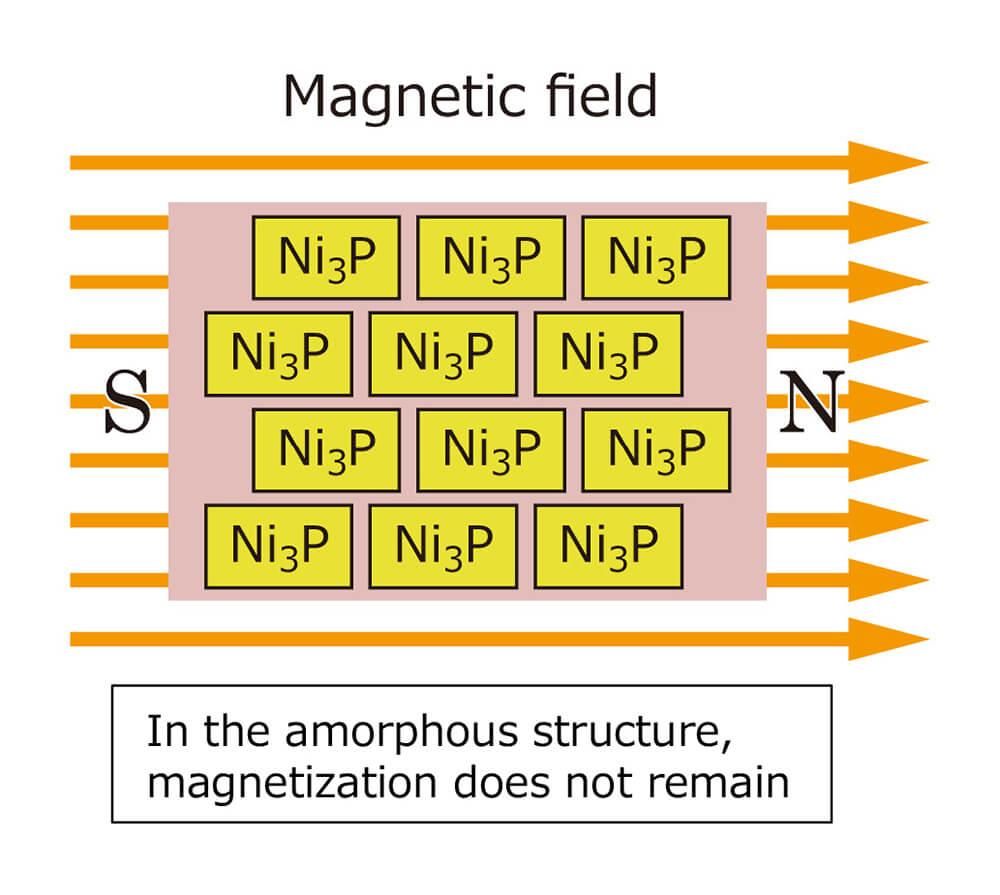
The difference in the atomic size between Ni (nickel) and P (phosphorus) causes a crystal lattice distortion and hinders domain wall motion, limiting the magnetic domain expansion. In a Ni-P alloy plating layer, P has a crystalline structure at a lower concentration and an amorphous structure at a higher concentration. Owing to its specific atom ratio and regular structure, the intermetallic compound Ni3P does not cause an exchange interaction; hence, it does not become ferromagnetic. Not having residual magnetization, Ni3P returns to a non-magnetic state when the magnetic field is removed. Depending on the content rate of P, the intensity of magnetization of the alloy changes.
<Comparison of our magnetic and non-magnetic nickel sulfamate plating>
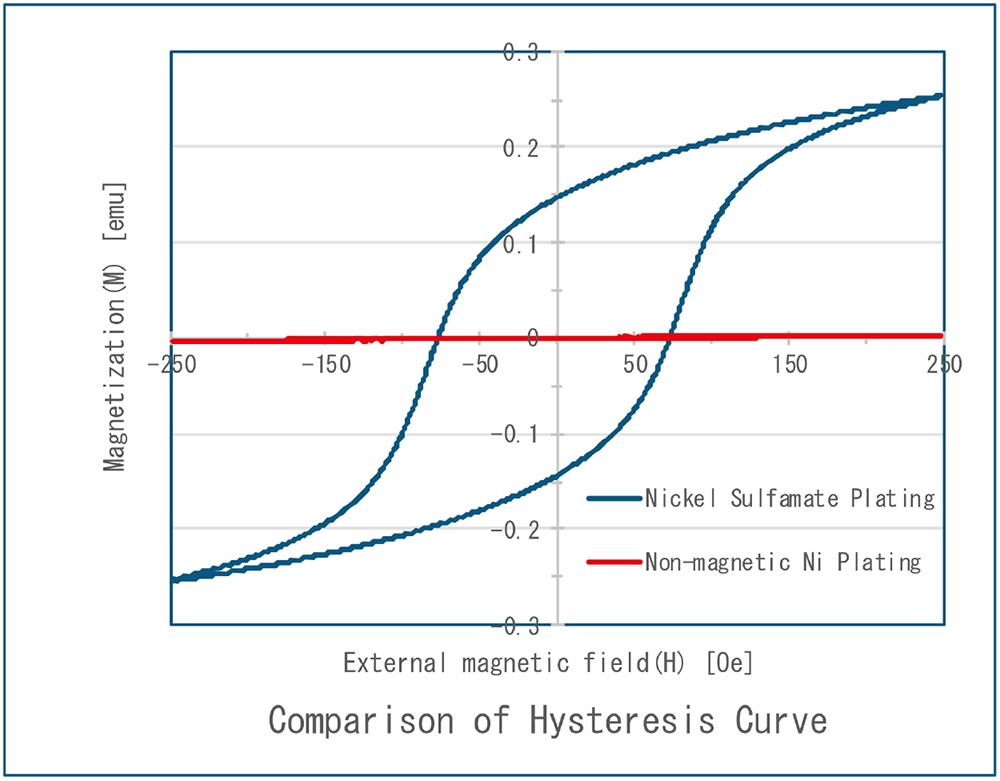
The following are the VSM measurement results of magnetic nickel sulfamate plating and non-magnetic nickel-phosphorus alloy plating using a nickel sulfamate bath, which is being developed by us. The results indicate that nickel sulfamate plating is magnetized when an external magnetic field is applied and a hysteresis curve is thus drawn, whereas non-magnetic nickel-phosphorus alloy plating is hardly magnetized, remaining at around zero.
【Main development objectives】
In this development, to meet customer needs, we are pursuing technology development with the following three objectives.
・Demagnetization of a nickel electroplating layer
We combine our accumulated technology and know-how on “nickel sulfamate plating” with those on “electroless nickel-phosphorus plating.” Through this, we aim to realize a plating layer without magnetism in electroplating using nickel sulfamate.
・High-speed plating
We take advantage of the feature of a nickel sulfamate bath: the ability to achieve thick plating at high current density. We aim to establish a technology that accommodates productive “high-speed plating” and “continuous electrolysis” while maintaining the performance of non-magnetism.
・Stable control of the phosphorus content rate
The rate of phosphorus content in a plating layer determines the properties of the plating layer, such as hardness and corrosion resistance. We are developing a technology to stably control the phosphorus content rate, aiming to provide plating layer properties that meet customer needs.
【Main features of the development object】
The non-magnetic nickel-phosphorus alloy plating technology using a nickel sulfamate bath, which is under development, has the following three excellent features that are absent in conventional nickel electroplating.
・Stable non-magnetism
The plating layer forms an amorphous structure in which atoms are irregularly arranged. This structure has no regular crystal alignment, which causes magnetism, realizing stable non-magnetism unaffected by an external magnetic field.
・High-hardness plating layer
When the plating layer is a nickel-phosphorus alloy, its internal structure changes, realizing a high-hardness plating layer (Hv500 to 700 in Vickers hardness). This feature improves the abrasion resistance of the plating layer.
・Superior corrosion resistance
Corrosion is likely to occur from a grain boundary, the boundary between metal crystals. An amorphous structure formed by the object under development does not have this grain boundary. Hence, it provides superior corrosion resistance compared with other nickel electroplating techniques, which yield a general crystal structure. This feature protects products for a long period even under a highly corrosive environment and enhances credibility.
【Stable supply and technical support backed by domestic production】
We develop and produce nickel sulfamate and other superior surface treatment agents within Japan, primarily at our R&D Center and Saitama Plant, thus ensuring the stable supply of our products.In addition, we developed a system for provision of attentive technical support in conjunction with our other domestic sites. This allows us to meet a diverse range of surface treatment needs. We offer solutions for a broad range of substrate materials and shapes; please do not hesitate to contact us with your inquiries.
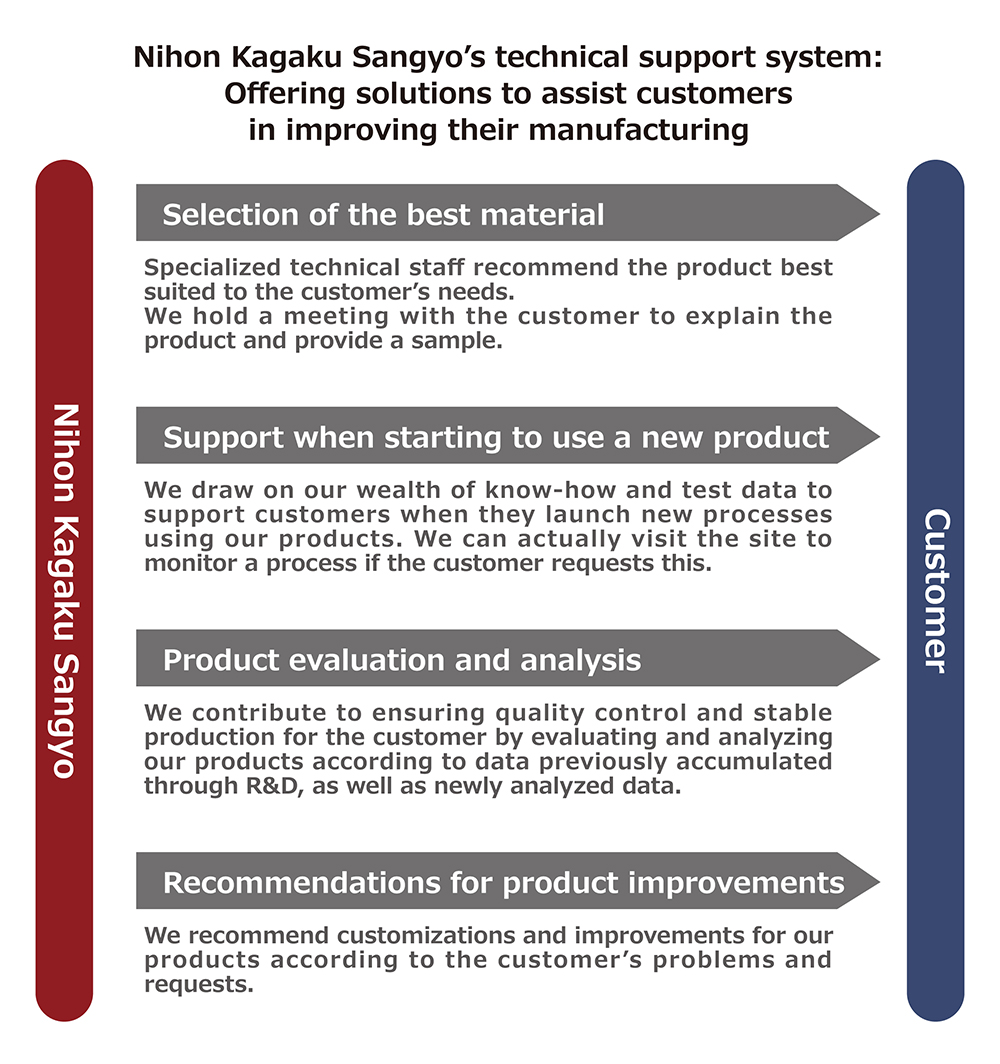
The R&D Center takes action according to the customer’s problems and requests, and also evaluates and analyzes our products. For more than 80 years, Nihon Kagaku Sangyo has stood alongside to its customers and assisted them in solving their issues.
Detailed product information and technical information on non-magnetic-nickel-sulfamate,
can be downloaded from here.